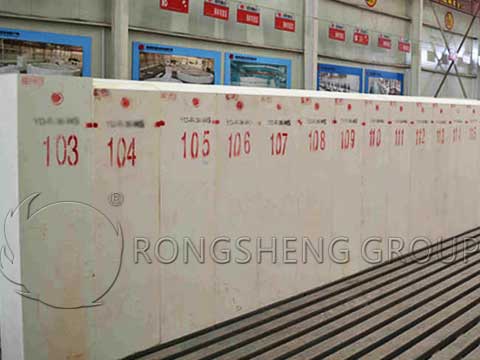
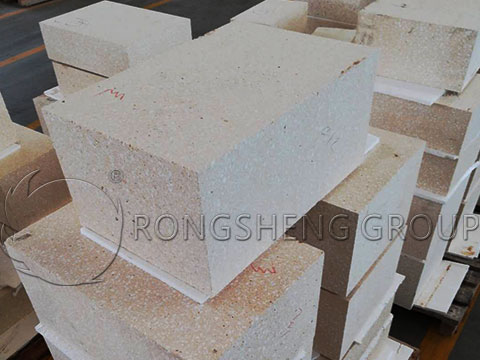
The Effect of AZS Refractory Bricks Fused Zirconia Corundum Bricks in Glass Furnaces

Fused zirconia-corundum bricks, commonly known as galvanized iron bricks or cast zirconia-corundum bricks, are the most important refractory materials for ensuring the normal operation of glass melting furnaces. Currently, the increased melting rate, extended furnace life, and reduced fuel consumption in glass melting furnaces both domestically and internationally are mainly achieved through the use of this refractory material.

Fused Zirconia-Corundum Bricks

Fused zirconia-corundum bricks, also known as corundum-zirconia products, have a main chemical composition of 50%-70% Al₂O₃, 20%-40% ZrO₂, and the remainder SiO₂. The main mineral composition is zircon (ZrO₂), corundum (α-Al₂O₃), and a glassy phase. Zirconia crystals form the backbone of the brick. ZrO₂ has a high melting point (2715℃), good chemical stability, and strong resistance to acidic and alkaline media, especially molten glass.
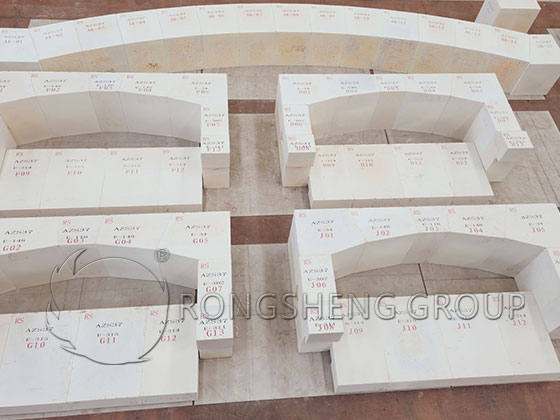
Glass Kiln AZS Refractory Bricks

The performance of fused zirconia-corundum bricks improves with increasing ZrO₂ content. Generally, zirconia-corundum bricks are graded according to ZrO₂ content, such as 33%, 36%, and 41% (or 30%, 40%, and 50%), but there is no unified standard. Currently, products containing 33% zirconium are most commonly used, with a density of 3.65-3.7 g/cm³ and a maximum operating temperature of around 1700℃.

Fused zirconia-corundum bricks are used in industrial furnaces such as glass melting furnaces. In glass melting furnaces, they are used for lining the upper tank walls, small furnace arches, small furnace stacks, tongue arches, and breast walls.

Precautions for using fused zirconia-corundum bricks:

  • (1) Irregular thermal expansion. The expansion curve of fused zirconia-corundum bricks exhibits an anomaly around 1000℃, where the internal ZrO₂ crystals undergo a reversible crystal transformation, resulting in significant volume changes. Therefore, products containing ZrO₂ are not suitable for use in areas where the temperature fluctuates rapidly around 1000℃. During furnace baking and kiln firing, the temperature change between 900 and 1150℃ should not be too large, generally not exceeding 15℃/h, and a steady temperature rise is required.
  • (2) Shrinkage cavities often appear at the casting port during casting, resulting in more pores and lower density in the brick. Therefore, when lining the walls of the glass melting tank, the shrinkage cavities should be directed inwards towards the furnace. If the casting port faces outwards, leakage of molten glass can occur when the brick is eroded to a very thin thickness. When used in the upper flame space of the furnace, the service life is very long, and leakage of molten glass does not occur. Therefore, the casting port is always directed outwards to extend the service life.
  • (3) When fused zirconia-corundum bricks are laid in contact with clay refractory bricks, eutectic melting will occur at a high temperature of 1300℃. Therefore, when selecting refractory materials, it is important to avoid laying two refractory materials with severe eutectic melting in contact. For example, silica bricks placed below fused zirconia-corundum bricks are most susceptible to erosion by the fused zirconia-corundum bricks.

AZS Refractory Bricks for Glass Furnaces

Electrominated zirconia-corundum products for glass furnaces are classified into three grades based on their zirconia content: AZS-33 (33% zirconia content), AZS-36 (36% zirconia content), and AZS-41 (41% zirconia content). The products are further classified into two grades: Y (first-class) and H (qualified) based on their physicochemical properties, dimensional tolerances, and appearance.


Physicochemical Indicators 33# fused zirconia-corundum bricks 36# fused zirconia-corundum bricks 41# fused zirconia-corundum bricks
SiO2 14–16 ≤14.0 ≤13.0
Al2O3 47.55–50 44.55–50.5 44–48
ZrO2 32–36 35–40 40–44
Na2O 1.4–1.5 1.4–1.6 ≤1.3
Fe2O3+TiO2+CaO+k2O ≤2.5 ≤2.5 ≤2.5
room temperature compressive strength(Mpa) 350 350 350
thermal expansion coefficient(%) 0.8 0.8 0.8
Glass phase eluent temperature(℃) >1400℃ >1400℃ >1410℃
Resistant to glass corrosion (1500℃, 36 hours, ordinary glass) ≤1.4 ≤1.3 ≤1.2
density Ordinary casting ≥3.4 ≥3.5 ≥3.55
Inclined casting ≥3.45 ≥3.55 ≥3.6
No shrinkage cavities in casting ≥3.7 ≥3.8 ≥3.9
Softening temperature under load at 0.2 MPa >1700℃ >1700℃ >1700℃

The Application Effects of AZS Refractory Bricks in Glass Furnaces

AZS refractory bricks, scientifically known as fused cast AZS bricks, primarily serve glass furnaces. They are made by completely melting the raw materials, casting them into a mold, and then cooling and solidifying them. Shrinkage cavities caused by volume shrinkage during solidification are a significant concern during use. AZS refractory bricks (fused zirconia-corundum bricks) can be cast using ordinary casting, inclined casting, shrinkage-cavity-free casting, and quasi-shrinkage-cavity-free casting methods. These different casting methods cater to the requirements of various parts of ceramic frit furnaces, sodium silicate furnaces, and glass furnaces. They are erosion-resistant, corrosion-resistant, and have a long service life. Currently, the most commonly used method is electrofusion oxidation casting.

The development and evolution of AZS refractory bricks are driven by three major factors. First, glass manufacturers often need to adjust glass quality supply and demand to maintain minimum standards. Second, financial requirements for glass furnaces necessitate longer furnace operating cycles. Third, the impact of pure oxygen combustion systems. These three requirements typically determine the selection of refractory bricks during kiln repairs. These factors also influence glass manufacturers’ selection of refractory materials during kiln maintenance and the adoption of new techniques for large-scale overhauls during the operating cycle.

The application of molten alumina bricks in the melting pool roof has established its use. It is particularly prevalent in pure oxy-fuel furnaces used for melting high-quality glass. Before the advent of pure oxy-fuel technology, only β-alumina bricks were used in the melting pool roof structure, and no molten alumina bricks were used for the melting pool roof. Currently, both β-alumina and α-β-alumina molten castings are used in the production of tin-fiber (screen cone), float glass, and borosilicate glass in pure oxy-fuel furnaces, either partially or entirely, on the furnace roof. Molten alumina bricks can typically operate up to 1600°C or 1650°C (depending on the glass product), while furnace roofs constructed with fused alumina bricks can operate successfully at 1700°C. This creates better conditions for glass manufacturers producing refractory glass. AZS refractory bricks offer a longer lining life in glass kilns.
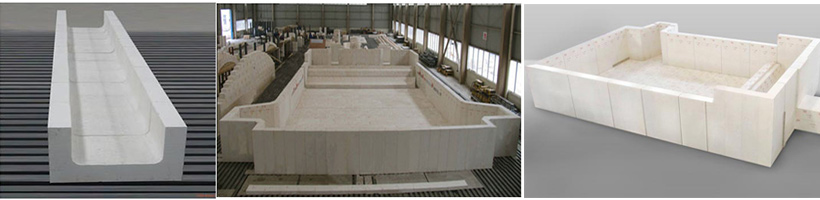
 

Electrofused AZS-33 Refractory Bricks for Glass Melting Furnaces

Fused cast zirconia-corundum (AZS) refractories are a unique type of refractory material, possessing a series of excellent properties such as dense structure, strong erosion resistance, and low contamination of molten glass. They are widely used in various glass melting furnaces in the building materials, light industry, pharmaceutical, and electronics industries, and are an indispensable key furnace-building material for glass melting furnaces.

Fused Cast Refractory Bricks Used in the Upper Structure of Glass Furnaces

In recent years, with the development of the glass industry, glass furnaces have become larger, with longer furnace lifespans, increased daily melting rates, and higher daily output. Glass melting and refining temperatures have increased, while the quality requirements for glass products have also risen. Energy and environmental protection issues have become increasingly prominent, and oxy-fuel combustion technology is attracting more and more attention from glass companies. Furthermore, overcapacity and fierce market competition have forced glass manufacturers to use cheaper fuels such as petroleum coke to reduce production costs. These changes in the glass industry have led to higher overall flame temperatures in glass furnaces and have also introduced large amounts of SO3, V2O5, water vapor, and alkaline volatiles, placing higher demands on refractory materials used in glass furnaces, especially fused cast AZS refractory materials used in the upper structure. Therefore, fused cast AZS refractory materials must undergo rigorous testing and quality supervision before use to ensure the safe and stable operation of glass furnaces and the production of high-quality glass products.

Glass Kiln AZS Refractory Bricks

Fused Cast AZS 33#

Fused cast zirconia-corundum refractories (AZS) are refractory products made primarily from industrial alumina, zirconium sand, and desilicationized zirconium, with a small amount of Na₂O flux added in the form of sodium carbonate. They are melted in an electric arc furnace and then cast into shape. Typically, based on zirconium dioxide content, fused cast AZS refractories are classified into three grades: 33#, 36#, and 41# (AZS33#, AZS36#, AZS41#).

AZS33# is the most widely used and extensively used product in the fused cast AZS series. It is mainly suitable for the upper structure of the melting pool, the walls and bottom of the working pool, and the feed channel. AZS36#, in addition to having the same aluminum-zirconium eutectic as AZS33# fused zirconia-corundum bricks, also contains more chain-like zirconium oxide crystals and has a lower glass phase content, thus further enhancing its corrosion resistance. Therefore, it is suitable for areas with high glass melt flow rates or high temperatures, such as critical parts like the tank walls near hot spots in the melting pool. AZS41# contains more uniformly distributed zirconium oxide crystals, and among the AZS series products for fused casting, it has the best corrosion resistance. Therefore, it is selected for critical parts of glass furnaces, such as the corners of the feeding inlet, flow channels, furnace sills, and bubbling areas at the bottom of the pool, to ensure that the lifespan of these parts is balanced with that of other parts.

Fused Chromium Zirconium Corundum Bricks

Fused chromium zirconium corundum bricks are produced by introducing 10%–30% Cr2O3 into AZS-33 bricks using a shrinkage-free casting method. They are abbreviated as AZCS bricks. The surface and interior of the brick are dark green. The brick contains 4.5% shrinkage pores and has no interconnecting pores. The formation of an aluminum chromium spinel solid solution increases the viscosity of the glass phase, greatly improving its resistance to glass melt erosion. This resistance is 3.4 times that of fused AZS-33 bricks and 2.6 times that of fused AZS-41 bricks.

Fused AZS Refractory Bricks for Glass Furnaces

Features of Fused Zirconia-Corundum Bricks

Fused AZS refractories are indispensable furnace-building materials for glass melting furnaces, and their production technology and quality directly affect the quality of molten glass and the furnace life. AZS bricks, based on their zirconium oxide content, can be classified into three grades: 33#, 36#, and 41#. The main raw materials for fused zirconia-corundum bricks are industrial alumina (Al2O3 content > 98.5%), zircon sand (ZrO2 content > 65.6%), desilicationized zirconium (ZrO2 content > 85%), soda ash (Na2CO3 content not less than 99%), borax (B2O3 content not less than 37%), and rare earth oxides (Y2O3 content not less than 45%).

When industrial alumina and zircon sand are mixed in a 1:1 ratio, the resulting refractory material contains approximately 33% ZrO2, i.e., AZS33# brick. Another raw material for producing high-quality fused cast AZS bricks is desilicationized zirconium, so AZS36# and AZS41# bricks must use it, and AZS33% bricks also use desilicationized zirconium to improve performance. Industrial alumina is produced by chemically treating bauxite raw materials to remove oxides of silicon, iron, titanium, etc. It is a high-purity alumina raw material, with an Al2O3 content generally above 98%. Desilicationized zirconium is produced by smelting zircon concentrate in an electric arc furnace using carbon as a reducing agent.

Zircon, also called zirconite, contains 67.1% ZrO2 and 32.9% SiO2. Zircon has a melting point of 2550℃, does not shrink when heated to 1750℃, has a small coefficient of linear expansion, and is chemically inert, difficult to react with acids, does not react with some molten metals, and has strong resistance to glass melt erosion. Therefore, the characteristics of fused zirconium corundum bricks are as follows:

  • (1) High temperature resistance.
  • (2) High compressive strength.
  • (3) Excellent thermal shock resistance.
  • (4) High bulk density and good thermal conductivity.
  • (5) Good wear resistance.
  • (6) Good resistance to acid and alkali corrosion.

Applications of AZS Bricks

AZS bricks are mainly used in key parts of high-temperature industrial metallurgical furnaces, such as steel, metallurgy, electronics, petrochemicals, fertilizers, non-ferrous metals, and refractory materials, including glass furnaces, fiberglass furnaces, waste incinerators, and electric furnaces.


RS Kiln Lining Refractory Materials for Glass Kilns

What are the Refractory Bricks for the Lining of the Glass Kilns? The lining of the glass kiln is subject to chemical erosion, mechanical erosion, and large temperature fluctuations, and the refractory materials used for the glass kiln lining are like…Contact RS Refractory Company for a Free Quote. Glass is mainly made by using silica sand and soda ash as raw materials through high-temperature melting. A Glass melting furnace is thermal equipment for melting glass, usually made of refractory bricks.

Fused AZS Refractory Bricks for Glass Furnaces

Refractory Materials for Glass Furnaces

Glass melting furnaces can be divided into two categories: pool kilns and crucible kilns. According to the operation mode, it is divided into continuous operation furnaces and intermittent operation furnaces. According to the heating method, it can be divided into the flame kiln and electric heating kiln. So, how should refractory bricks be used in glass kilns? Perhaps manufacturers of refractory materials for glass kilns will answer such questions for us. Refractory Bricks Used for Glass Kiln. Because refractory bricks are widely used, from low temperature to medium temperature to high temperature, it is a necessity for the construction of the lining structure of industrial kilns.

When we choose refractory materials, we must consider many aspects. How to choose our applicable refractory brick products. First, we need to see which type of brick we need. Refractory bricks have different brick types and different uses. Secondly, we must see which kind of furnace is used and then the quality of refractory bricks. When determining the demand, the quality of the refractory bricks meets the standard and then compares the prices. Selection of refractory bricks for glass kiln is the most common type of kiln used in the glass industry. It is made of refractory bricks. There are flame-type pool kilns and electric-heated pool kilns.

The crucible kiln is to put the glass batch materials into the crucible, and then put them in the kiln to heat them together and then pour them into glass products after the materials are melted. The characteristic of this kiln is that the molten glass does not directly contact the kiln lining and the crucible is generally made of high-alumina refractory bricks and clay refractory bricks. The damage to the lining of the glass melting furnace is mainly chemical erosion and has the effect of thermal stress. The degree and speed of chemical attack are closely related to the location of use, the temperature of the furnace, and the type of molten glass. Of course, the quality of the lining itself is also very important. When choosing refractory bricks for glass melting furnaces (https://www.hy-refractory.com/service/product_knowledge/glass-tank-furnace-refractories.html), consideration should be given to the type of furnace, the location of its use, and its damage mechanism, the type of melting glass, and the type of fuel.

Fused AZS Bricks for Glass Kiln

Fused Zirconia Corundum Bricks for Glass Kilns

Fused Zirconia Corundum Bricks. Categories Refractory Bricks. WikiTags: Lining of the Glass Kilns, Refractory Bricks. At present, fused zirconia corundum bricks and corundum bricks are widely used at home and abroad at the wall and bottom of the glass kiln in contact with the molten glass. The lower layer of the melting pool is built with clay refractory bricks. What are the precautions when using clay refractory bricks in the glass kiln? Clay refractory bricks are commonly used refractory bricks in blast furnaces, hot blast stoves, heating furnaces, ceramics, and refractory brick firing kilns. In order to achieve the best results, we need to pay attention to the following matters when used in a glass furnace.

Large Fireclay Refractory Bricks for Glass Kiln

Large Fireclay Bricks for the Glass Kilns

Large Fireclay Bricks for the Glass Kilns. 1. Clay refractory bricks cannot bear weight or be compressed when used at high temperatures. Therefore, it can only be used on the lower part of the pool wall or at a lower temperature at the bottom of the pool. 2. The gap between refractory bricks is controlled within 1.5mm~2mm. 3. The inside of the kiln shell should be flat without unevenness, let alone tilted.4. When using refractory bricks, clean the dust and slag scraps on the inner wall of the kiln shell to avoid loosening. 5. Leave a little expansion joint between the refractory bricks. 6. Bond clay refractory bricks with special cement for refractory bricks. 7. The lining of important parts and parts with complex shapes should be pre-laid first. 8. The lock seam should be firm. When processing bricks, bricks should be finely processed with a brick cutter, and manual processing of bricks should not be used. The capped bricks in the rotary kiln and under the brick slabs should not be less than 70% of the original bricks. In flat joint bricks and curved bricks, it shall not be less than 1/2 of the original bricks. It must be locked with original bricks. The processing surface of the brick should not face the inner side of the furnace. 9. Clay refractory bricks must be stored in a dry warehouse. Having mastered the selection techniques and methods of these refractory brick materials for glass kilns, I believe you will easily find the refractory bricks for glass kilns that best suit your production needs. For more information, please stay tuned to this blog.

And also the Insulating Fire Bricks Used for Kiln Linings. Insulating Fire Bricks of different materials, when used for kiln linings, can increase the heat storage function of industrial kilns and reduce the loss of energy…  Contact Rongsheng for Free Quote of Refractory Bricks Categories.