Rongsheng Refractories specializes in the production of a wide range of refractory materials. Its product portfolio includes refractory bricks—such as high-alumina and fireclay bricks—as well as various refractory castables, including low-cement, high-alumina, lightweight, and wear-resistant varieties. The company has developed shaped products (including aluminum silicate, silica-based, basic, and lightweight insulating brick series) and other refractory materials tailored for industries such as coking, building materials, iron and steel, non-ferrous metals, and electric power.
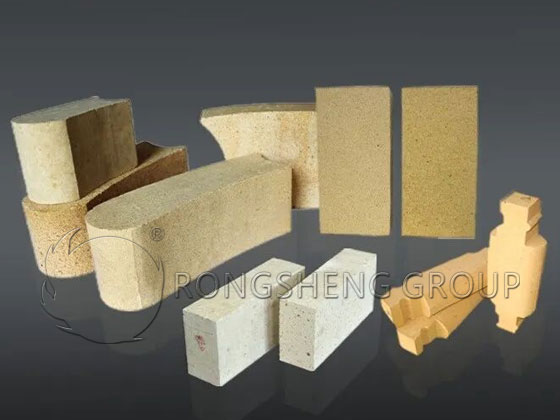
Refractory Brick Designations
There is a wide variety of refractory brick designations, and the shapes and dimensions involved are quite complex; however, standardized designation codes have been established. These codes reveal the brick’s intended application, as well as its shape, dimensions, and weight. For instance, bricks with the “T” prefix are used in general industrial furnaces; this series ranges from “T-1” to “T-105,” comprising over 20 shapes and 105 specific designations (specifications)—such as the “T-3” standard brick, which measures 230 × 114 × 65 mm. Similarly, bricks with the “G” prefix are designed for blast furnaces; the “G-1” through “G-8” series includes two shapes and eight specifications. The table below lists several refractory brick designations and their applications:
| Designations | Uses | Designations | Uses |
| D-1~D-17 | For electric furnaces | C-1~C-27 | Steel ladle lining brick |
| P-1~P-64 | For open-hearth furnaces | X-1~X-10 | Steel ladle sleeve brick |
| G-1~G-8 | For blast furnaces | S-1~S-8 | Steel ladle stopper brick |
| R-1~R-28 | For hot-blast stoves | ZH-1~ZH-9 | Steel ladle nozzle brick |
| H-1~H-12 | For cupolas | Z-1~Z-6 | Steel ladle well block |
| T-1~T-105 | For general industrial furnaces | L-1~L-6 | Pouring funnel brick |
| ZG-1~ZG-4 | Casting bricks for cast pipes | ZL-1 | Intermediate pouring funnel brick |
| ZX-1~ZX-23 | Casting center bricks | ZL-2 | Intermediate pouring funnel nozzle brick |
| LG-1~LG-15 | Casting runner bricks | MD-1~MD-6 | Ingot mold bottom brick |
SK32, SK34, SK36, SK38, and SK40 Refractory Bricks
Refractory bricks are bricks capable of withstanding high temperatures exceeding 1580°C. They are produced by mixing refractory clay with grog (calcined and crushed clay), pressing the mixture into shape, drying it, and finally firing it. Other types include silica bricks and high-alumina bricks. Based on grade designations, they are classified as SK32, SK34, SK36, SK38, and SK40 refractory bricks. These bricks are primarily used for furnace linings, flues, and chimneys, and are categorized by shape and specification into two main types: standard and special-shaped. Standard refractory bricks measure 230 mm × 114 mm × 65 mm, while special-shaped bricks are either processed on-site to meet specific needs or manufactured using custom molds.
Based on their heat resistance, refractory bricks are classified into ordinary types (refractoriness of 1580–1770°C) and high-grade types (refractoriness of 1770–2000°C). Chemically, they are classified into three categories: acidic, basic, and neutral.
Rongsheng is a specialized manufacturer of refractory bricks, offering products such as the SK series, special-grade, first-grade, and second-grade refractory bricks, as well as special-shaped bricks. Rongsheng’s refractory bricks are characterized by wear resistance, corrosion resistance, spalling resistance, low creep, excellent thermal shock stability, and a long service life. They are primarily used for linings in blast furnaces, hot blast stoves, carbon baking furnaces, carbon calcining furnaces, coke ovens, steel ladles, casting systems, boilers, cement kilns, glass kilns, and various other industrial furnaces and thermal equipment. They serve industries such as metallurgy, machinery, building materials, casting, ceramics, electric power, petroleum, and chemicals.
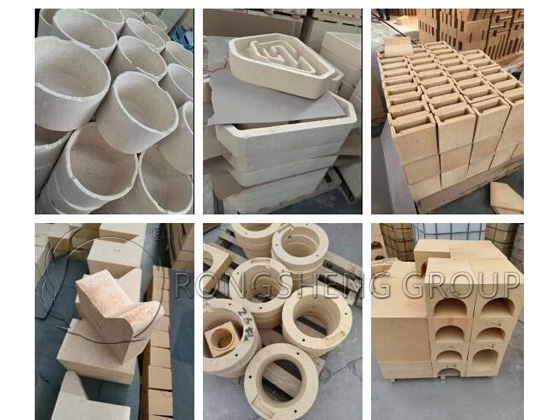
Standards for Refractory Materials
The standard size for refractory materials is 230 × 114 × 65 mm. According to national standards, refractory bricks are classified into various types—commonly including straight bricks—suitable for different construction projects and industrial equipment. General-purpose refractory bricks refer to straight bricks, side-tapered bricks, edge-tapered bricks, end-tapered bricks, and skewback bricks used for masonry in the straight walls and arched sections of thermal equipment such as industrial furnaces and kilns. The dimensions for general-purpose refractory bricks (specifically the T-3 type) are 230 × 114 × 65 mm; national and ministerial standards are largely consistent. Dimensions (Length × Width × Thickness) and volumes are as follows: T-1 (172 × 114 × 65 mm, 1274.5 cm³), T-2 (230 × 114 × 32 mm, 839 cm³), T-3 (230 × 114 × 65 mm, 1704.3 cm³), and T-4 (230 × 172 × 65 mm, 2571.4 cm³). Among these, the standard refractory brick size is T-3 (230 × 114 × 65 mm) with a volume of 1704.3 cm³.
Refractory Brick Dimensions
Rongsheng Refractory Brick Manufacturer offers general-purpose refractory bricks—including models, specifications, and dimensions—suitable for industrial furnaces, kilns, and other thermal equipment.
Naming Convention for Refractory Brick Models and Codes
In the brick model number, the letter “T” represents the Pinyin initial for “General-purpose” (Tongyong). Following the hyphen is a sequential number.
In the code, the letters Z, C, S, K, and J represent the Pinyin initials for the brick types: Straight (Zhi), Side-wedge (Ce), Vertical-wedge (Shu), Wide-wedge (Kuan), and Arch-foot (Jiao). For straight bricks, the letter is followed by the hundreds and tens digits of the brick length (*a*), then the tens digit of the brick thickness (*c*). For wedge bricks, the letter is followed by the hundreds and tens digits of the distance (*b*) between the large and small ends, then the digits (tens place and above) for the large-end dimension (*a*) and small-end dimension (*a1*); the suffix “k” indicates a staggered-joint wide brick. For arch-foot bricks, the letter is followed by the hundreds and tens digits of the inclined surface length (*L*), then the tens digit of the inclination angle.
Specifications for refractory bricks include their model, shape, name, code, dimensions, and parameters.
In effect, every skewback brick incorporates a right-angled triangle; that is, the brick features two complementary inclination angles. For instance, a skewback brick with an inclination angle of 52° has a complementary angle of 38°; thus, a 38° skewback required for an arch with a central angle of 104° can utilize the complementary angle of a 52° skewback brick. This method of utilizing complementary angles is sometimes applied to furnace roof skewbacks with thicknesses of 380 mm and 440 mm. Consequently, standard inclination angles for skewbacks include 30°, 38°, 45°, 52°, and 60°. The length of the inclined face (L) of the skewback brick should match the dimension (b) between the large and small ends of the mating wedge brick; common values for this dimension are 114, 230, 300, 380, and 440 mm.
The thickness (c) of the skewback brick should correspond to the effective thickness (c) of the mating wedge brick; for example, skewback bricks used with side-wedge bricks have a thickness of 230 mm, while those used with 230 mm vertical-wedge bricks have a thickness of 114 mm. To reduce weight, the thickness of skewback bricks with inclined face lengths of 300, 380, and 400 mm is halved to 75 mm. However, when constructing stepped inclined roofs, it is often observed that two skewback bricks laid side-by-side result in a combined thickness exceeding the 150 mm width of the arch brick ring. Due to the extra mortar joint, combined with positive dimensional tolerances and surface irregularities, the total thickness can reach 160 mm, creating significant difficulties for inclined roof construction. To rectify this issue, the standard thickness for skewback bricks was revised to 73 mm. While the dimensions of the two right-angle sides of the skewback brick can be calculated based on the inclination angle, specific standards are established to facilitate manufacturing, storage, and optimal performance.