Refractoriness is essentially the temperature at which a material softens under its own weight to a specific cone number. It is primarily determined by its chemical composition: the higher the content of high-melting-point oxides such as Al₂O₃, MgO, Cr₂O₃, and ZrO₂, the later the liquid phase appears, resulting in higher refractoriness. Conversely, the higher the content of fluxing impurities such as K₂O, Na₂O, and Fe₂O₃, the earlier the low-temperature liquid phase forms, thus decreasing refractoriness. Secondly, even with the same formula, insufficient firing temperature, low matrix sintering degree, and high glass phase content will also lower the refractoriness. Therefore, differences in refractoriness stem from the raw materials and firing temperature. In other words, “materials” and “fire” are inherent conditions; the absence of either determines the refractoriness.
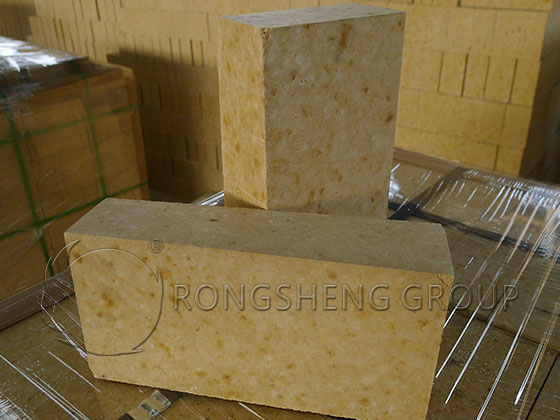
Refractoriness of High-Alumina Refractory Bricks
The refractoriness of high-alumina refractory bricks varies depending on the aluminum content, impurity composition, and manufacturing process. Specific ranges are as follows:
- Ordinary high-alumina bricks: Alumina content between 48% and 75%, refractoriness generally between 1750℃ and 1790℃.
- High-alumina bricks (alumina content 75%-95%): Refractoriness increased to 1790℃-1850℃.
- Corundum high-alumina bricks (alumina content ≥95%): Refractoriness can reach 1850℃-2000℃.
It should be noted that refractoriness is the softening temperature of a material under no-load, no-corrosion conditions. In practical applications, suitability should be comprehensively evaluated in conjunction with load softening temperature, slag resistance, thermal shock resistance, and other indicators.
Testing of Refractoriness
In the past decade, production lines have almost completely stopped routinely testing refractoriness for two reasons:
First, with the standardization of raw materials and the improved temperature control precision of tunnel kilns or shuttle kilns, the refractoriness fluctuation range of the same grade of bricks has been reduced to within ±10℃, rendering testing meaningless.
Second, users are more concerned with “operating condition indicators” such as load softening temperature, thermal shock resistance, slag resistance, and creep rate, which directly determine the furnace lining life. Refractoriness, however, is merely a threshold value for “not melting” and cannot characterize structural strength or erosion behavior, thus naturally taking a backseat.
Overview of Refractories in Acid, Alkali, and Neutral Brick Systems
- Acidic System: Typically silica bricks (SiO₂≥94%), refractoriness approximately 1710℃. Higher than clay bricks, but with poor thermal shock resistance and a loose structure at high temperatures, suitable only for static applications such as coke ovens and glass kiln roofs.
- Neutral System:
-
- ① Clay bricks: refractoriness 1580~1690℃.
- ② High-alumina bricks: refractoriness increases to 1750~1790℃.
- ③ Corundum bricks: can reach over 1850℃.
- Alkali System:
Magnesium bricks (MgO≥87%), magnesia-chrome bricks, and magnesia-zirconium bricks, due to the periclase melting point of 2800℃ and their high-purity, high-density matrix, generally have a nominal refractoriness of 2000℃, making them the highest among commonly used bricks.
The “Misalignment” Between Refractoriness and Service Temperature
Refractory temperature is the softening point under no load and no corrosion in a laboratory setting. Service temperature, on the other hand, is the extreme working surface temperature under load and chemical erosion in an industrial furnace. The two are not equivalent.
Empirically, high-alumina bricks have a refractoriness ≥1700℃ and a safe service temperature of approximately 1350℃. Corundum bricks have a refractoriness ≥1800℃ and a service temperature of approximately 1400℃. Basic bricks have a refractoriness standard of 2000℃, and their service temperature can be relaxed to 1700℃. In short, refractoriness provides a “temperature reserve,” while the service temperature must be reduced by a triple safety factor considering mechanical load, chemical corrosion, and thermal shock fatigue.
The Hidden Value Behind Refractoriness
While refractoriness has been marginalized, it remains a key indicator of slag resistance and creep performance. Higher main phase content and lower impurity levels lead to increased refractoriness while simultaneously reducing the amount of liquid phase and permeation channels, naturally enhancing erosion resistance.
Similarly, high refractoriness implies a high load softening temperature. Materials can maintain a structure with less glassy phase and a complete crystalline framework even above 1300℃, thus possessing the foundation for erosion and permeation resistance. Therefore, refractoriness is not useless; it simply relinquishes its role to more specific physicochemical indicators that characterize working conditions, while remaining a fundamental aspect of quality.
In short, refractoriness is determined by the combination of raw materials and firing temperature. While no longer measured daily, it remains a “birth certificate” for material purity and potential performance. When selecting kilns for engineering projects, first check the refractoriness to determine the upper limit, and then test indicators such as load softening, slag resistance, and thermal shock resistance to ensure that the kiln has a long service life, stable production, and low consumption.