Refractory materials used in thermal power generation projects are diverse. Based on application scenarios and performance requirements, they can be mainly classified into the following categories:
Shaped Refractory Products
- Clay Refractory Bricks: Made primarily of refractory clay, containing 30%-46% alumina, with a refractoriness of 1580-17700℃, good thermal shock resistance, suitable for boiler walls, furnace roofs, etc., and resistant to acidic slag corrosion.
- High-Alumina Refractory Bricks: Containing 48%-90% alumina, with a refractoriness ≥1700℃, high compressive strength, and high load softening temperature, commonly used in high-temperature areas of boilers, such as the furnace chamber and furnace bottom, and also exhibiting some resistance to alkaline slag corrosion.
- Silica Bricks: Containing over 94% silica, with strong resistance to acidic slag corrosion and a high load softening temperature, but poor thermal shock resistance. Primarily used in acidic environments such as coke ovens and glass melting furnaces, and less commonly used in boiler bodies in thermal power generation, mostly in auxiliary equipment.
- Magnesia bricks: with magnesium oxide as the main component, containing more than 80%-85% magnesium oxide, the refractoriness is higher than that of clay bricks and silica bricks. They have good resistance to alkaline slag and iron slag and are often used in alkaline environments such as open-hearth furnaces and oxygen-blown converters. They are also used in specific high-temperature equipment in thermal power generation.
Unshaped Refractory Materials
- Refractory Castables: Composed of aggregates, fine powder, and binders, delivered in a dry state. Mixed with water before casting. Suitable for complex-shaped parts such as boiler furnaces, bottoms, and tops. Common types include clay-based, high-alumina, phosphate-bonded, and water glass-bonded. Features high compressive strength, thermal shock resistance, and abrasion resistance.
- Refractory Plastics: Composed of aggregates, fine powder, binders, and liquid. Possesses good plasticity. Applied by ramming. Hardens upon heating after application. Suitable for boiler furnace walls and tops. Adaptable to complex shapes and temperature changes, offering good thermal shock resistance and abrasion resistance.
- Refractory Rammed Mixtures: Non-adhesive before use. Applied by ramming. Suitable for boiler furnace bottoms and walls. Forms a dense refractory layer with high compressive strength and abrasion resistance.
- Refractory mortar: Composed of refractory powder, binder, and additives, it is mixed with water to form a slurry. It is used as a joint material for shaped refractory products, ensuring the sealing and refractoriness of the joints.
Insulating Refractory Materials
- Insulating Refractory Bricks: Such as clay insulating bricks, high-alumina insulating bricks, diatomaceous earth insulating bricks, etc., with a true porosity ≥45%, low bulk density, and low thermal conductivity, used as insulation layers in boiler furnace walls, roofs, and bottoms to reduce heat loss.
- Ceramic Fiber Products: Including ceramic fiber blankets, ceramic fiber boards, ceramic fiber modules, etc., these products are heat-resistant (up to 1260℃ and above), have extremely low thermal conductivity, and good thermal shock resistance. They are used for insulation and heat preservation in boiler furnaces, roofs, and walls, effectively reducing heat loss.
- Rock wool products: Made from natural rock through high-temperature melting, they possess low thermal conductivity, high refractory limit, and good mechanical strength. They are used for heat insulation and thermal insulation of boiler furnace walls, roofs, and bottoms, and are particularly suitable for environments requiring fireproofing and heat insulation.
The selection of the above refractory materials must be based on a comprehensive consideration of factors such as the specific application scenario of the thermal power plant project, temperature, slag properties, and mechanical load to ensure the safe and efficient operation of boilers and other equipment.
How to Implement High-Temperature Thermal Insulation Solutions for Power Plants?
A thermal power plant, or CDP, is a factory that uses the chemical energy of coal, oil, natural gas, or other fuels to produce electricity. A thermal power plant’s generator unit consists of three main components: a boiler, a steam turbine, and a generator, along with numerous auxiliary equipment and piping.
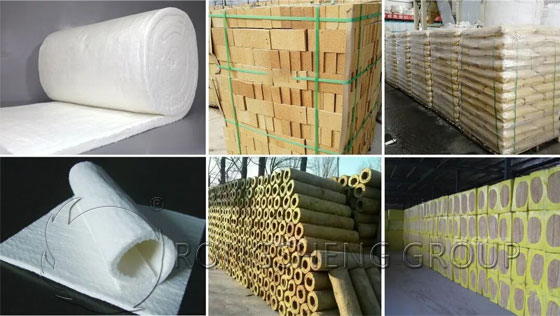
Common Thermal Insulation Materials for Power Plants
External thermal insulation materials for power plants: Aluminum silicate fiber blankets, rock wool, glass wool, silicate boards, felt, pipe shells, boards, cloth, calcium silicate boards, pipe shells, aerogel composite insulation felt.
Other refractory materials for power plant insulation: Acid-resistant castables, wear-resistant castables, various light and heavy castables, refractory bricks, insulating bricks.
Zoned Thermal Insulation Solutions for Power Plants
The key to power plant insulation is first to divide the area into three main insulation zones based on application zoning. After on-site investigation, each zone is divided into three main insulation sections, and then insulation solutions are designed for each section.
High-Temperature Insulation Solution for Power Plant Boilers
Power plant boiler insulation includes the boiler body and some auxiliary equipment. Fuel burns in the boiler furnace, releasing heat energy. This heat is transferred through the metal walls, converting the water in the boiler into superheated steam with a certain pressure and temperature. The steam is then sent to the turbine, which drives the generator to produce electricity. The temperature of the superheated steam inside the boiler is 540℃.
Power Plant Boiler Body Insulation Solution
The main insulation layer of the power plant boiler body consists of: high-temperature anti-corrosion coating (anti-corrosion layer) + 100mm rock wool felt or ceramic fiber blanket (insulation layer) + galvanized flexible wire mesh (binding layer) + plastering material (surface layer) + ceramic fiber blanket (protective layer b) + fiberglass cloth (protective layer a) + aluminum powder heat-resistant paint (surface layer).
Insulation Material Selection for Other Insulation Components of the Boiler Insulation System
- Boiler Water-Cooled Wall Insulation: Alumina Bricks + Rock Wool Board
- Furnace Top Cover Insulation: Ceramic Fiber + Rock Wool Board
- Furnace Top Cover Top Insulation: Refractory Castable
- Furnace Inner Header Insulation: Ceramic Fiber Board, Ceramic Fiber Blanket
- Steam Drum Insulation Material: Ceramic Fiber Blanket + Rock Wool Board
- Downcomer Insulation: Ceramic Fiber Board, Ceramic Fiber Blanket + Rock Wool Board
- Furnace Wall Insulation at Flue Corner: Ceramic Fiber Modules, Ceramic Fiber Blanket + Rock Wool Board
- Air Preheater Insulation Material: Ceramic Fiber Board, Ceramic Fiber Modules, Ceramic Fiber Blanket + Rock Wool
- Boiler Hot Air Duct Insulation: Ceramic Fiber Blanket Insulation + Rock Wool
- Boiler Body Flue Insulation: Ceramic Fiber Module Insulation, Ceramic Fiber Blanket + Rock Wool
- Electrostatic Precipitator Insulation: Rock Wool Board
High-Temperature Insulation Solutions for Steam Turbines
A steam turbine is a rotary power machine whose primary function is to convert the thermal energy of steam into mechanical energy.
The correctness and rationality of the structural design of the steam turbine insulation device, and the appropriateness of the selection of insulation materials, are crucial to the thermal economy and long-term operational safety of the steam turbine unit.
In the past, some power plant and shipyard steam turbines suffered from unreasonable insulation device structural design and inappropriate insulation material selection. This resulted in large temperature differences between the upper and lower cylinders, as well as large temperature differences between the inner and outer walls of the cylinders and flanges, leading to severe unit deformation and affecting the safe operation of the unit.
In my country, some power plants, shipyards, and industrial steam turbines have gradually replaced their insulation with new, detachable insulation structures. The lower cylinder uses a fixed insulation structure.
Upper Cylinder
Detachable insulation sleeve + outer protective layer (stainless steel plate or fiberglass), manufactured in sections and modules.
The inner layer of the removable insulation jacket for the steam turbine is either high-temperature resistant ceramic fiber cloth (resistant to 1260℃, long-term use at 1000℃) or high-silica cloth (resistant to 1000℃, long-term use at 950℃).
The inner core layer of the removable insulation jacket is a 240mm ceramic fiber blanket.
The outer layer of the removable insulation jacket for the steam turbine is silicone cloth.
Lower Cylinder
Fixed insulation structure (similar to boiler body insulation), insulation thickness is 1.1 times that of the upper cylinder.
Cylinder center split flange
Removable insulation jacket + outer protective layer (stainless steel plate or fiberglass), manufactured in sections and blocks.
Different insulation materials can be replaced according to actual application conditions, thereby changing the thickness and size to meet the insulation installation requirements of tight spaces between equipment.
Steam Pipeline Insulation Solution for Power Plants
A detachable insulation structure is adopted, with an insulation layer thickness of 180mm (90mm x 2 layers of ceramic fiber blanket).
Inner layer of the steam pipeline insulation jacket: Medium-alkali fiberglass cloth (resistant to 600℃, long-term use at 450℃);
Inner core layer of the steam pipeline insulation jacket: 180mm ceramic fiber blanket;
Outer layer of the steam pipeline insulation jacket: Silicone cloth/fiberglass reflective cloth.
The thickness of the inner core of the detachable insulation jacket is adjusted according to the three different pipe temperatures.
The Thermal Ceramic Detachable and Reusable Insulation Jacket (Pack) is a new generation of flexible thermal insulation product. Its advantages include detachability and reusability, meeting the insulation requirements of high-temperature working bodies that require regular maintenance or inspection.
Advantages of using detachable insulation sleeves on steam turbines:
- Low thermal conductivity, excellent insulation effect;
- Saves installation and maintenance time, significantly shortening the construction cycle and indirectly generating profits;
- Can be disassembled and reused multiple times;
- Flexible insulation, resistant to stepping and impact;
- Outer layer is oil and water resistant, and resistant to acid and alkali corrosion;
- Multiple installation options, convenient installation with no exposed areas;
- Beautiful and clean product appearance, washable surface;
- Long service life.