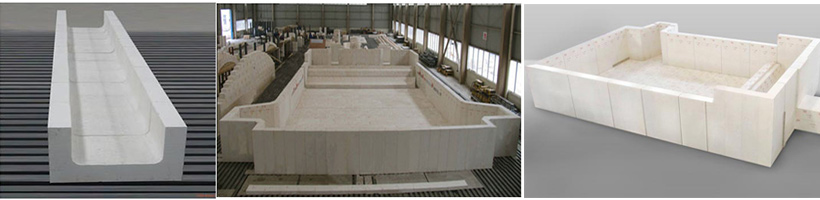
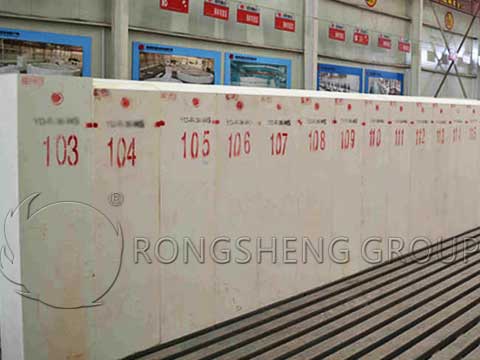
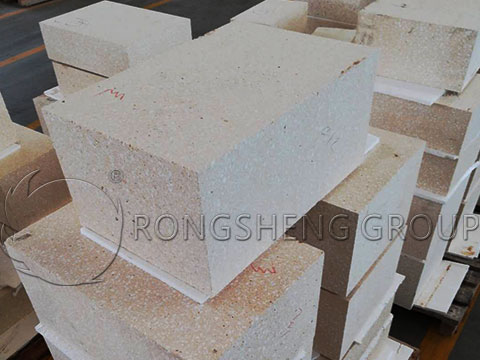
Fused zirconia-corundum bricks, commonly known as galvanized iron bricks or cast zirconia-corundum bricks, are the most important refractory materials for ensuring the normal operation of glass melting furnaces. Currently, the increased melting rate, extended furnace life, and reduced fuel consumption in glass melting furnaces both domestically and internationally are mainly achieved through the use of this refractory material.
Fused Zirconia-Corundum Bricks
Fused zirconia-corundum bricks, also known as corundum-zirconia products, have a main chemical composition of 50%-70% Al₂O₃, 20%-40% ZrO₂, and the remainder SiO₂. The main mineral composition is zircon (ZrO₂), corundum (α-Al₂O₃), and a glassy phase. Zirconia crystals form the backbone of the brick. ZrO₂ has a high melting point (2715℃), good chemical stability, and strong resistance to acidic and alkaline media, especially molten glass.
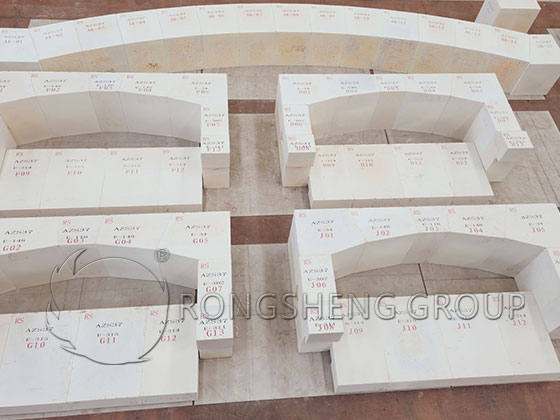
The performance of fused zirconia-corundum bricks improves with increasing ZrO₂ content. Generally, zirconia-corundum bricks are graded according to ZrO₂ content, such as 33%, 36%, and 41% (or 30%, 40%, and 50%), but there is no unified standard. Currently, products containing 33% zirconium are most commonly used, with a density of 3.65-3.7 g/cm³ and a maximum operating temperature of around 1700℃.
Fused zirconia-corundum bricks are used in industrial furnaces such as glass melting furnaces. In glass melting furnaces, they are used for lining the upper tank walls, small furnace arches, small furnace stacks, tongue arches, and breast walls.
Precautions for using fused zirconia-corundum bricks:
- (1) Irregular thermal expansion. The expansion curve of fused zirconia-corundum bricks exhibits an anomaly around 1000℃, where the internal ZrO₂ crystals undergo a reversible crystal transformation, resulting in significant volume changes. Therefore, products containing ZrO₂ are not suitable for use in areas where the temperature fluctuates rapidly around 1000℃. During furnace baking and kiln firing, the temperature change between 900 and 1150℃ should not be too large, generally not exceeding 15℃/h, and a steady temperature rise is required.
- (2) Shrinkage cavities often appear at the casting port during casting, resulting in more pores and lower density in the brick. Therefore, when lining the walls of the glass melting tank, the shrinkage cavities should be directed inwards towards the furnace. If the casting port faces outwards, leakage of molten glass can occur when the brick is eroded to a very thin thickness. When used in the upper flame space of the furnace, the service life is very long, and leakage of molten glass does not occur. Therefore, the casting port is always directed outwards to extend the service life.
- (3) When fused zirconia-corundum bricks are laid in contact with clay refractory bricks, eutectic melting will occur at a high temperature of 1300℃. Therefore, when selecting refractory materials, it is important to avoid laying two refractory materials with severe eutectic melting in contact. For example, silica bricks placed below fused zirconia-corundum bricks are most susceptible to erosion by the fused zirconia-corundum bricks.
AZS Refractory Bricks for Glass Furnaces
Electrominated zirconia-corundum products for glass furnaces are classified into three grades based on their zirconia content: AZS-33 (33% zirconia content), AZS-36 (36% zirconia content), and AZS-41 (41% zirconia content). The products are further classified into two grades: Y (first-class) and H (qualified) based on their physicochemical properties, dimensional tolerances, and appearance.
| Physicochemical Indicators | 33# fused zirconia-corundum bricks | 36# fused zirconia-corundum bricks | 41# fused zirconia-corundum bricks | |
| SiO2 | 14–16 | ≤14.0 | ≤13.0 | |
| Al2O3 | 47.55–50 | 44.55–50.5 | 44–48 | |
| ZrO2 | 32–36 | 35–40 | 40–44 | |
| Na2O | 1.4–1.5 | 1.4–1.6 | ≤1.3 | |
| Fe2O3+TiO2+CaO+k2O | ≤2.5 | ≤2.5 | ≤2.5 | |
| room temperature compressive strength(Mpa) | 350 | 350 | 350 | |
| thermal expansion coefficient(%) | 0.8 | 0.8 | 0.8 | |
| Glass phase eluent temperature(℃) | >1400℃ | >1400℃ | >1410℃ | |
| Resistant to glass corrosion (1500℃, 36 hours, ordinary glass) | ≤1.4 | ≤1.3 | ≤1.2 | |
| density | Ordinary casting | ≥3.4 | ≥3.5 | ≥3.55 |
| Inclined casting | ≥3.45 | ≥3.55 | ≥3.6 | |
| No shrinkage cavities in casting | ≥3.7 | ≥3.8 | ≥3.9 | |
| Softening temperature under load at 0.2 MPa | >1700℃ | >1700℃ | >1700℃ | |
The Application Effects of AZS Refractory Bricks in Glass Furnaces
AZS refractory bricks, scientifically known as fused cast AZS bricks, primarily serve glass furnaces. They are made by completely melting the raw materials, casting them into a mold, and then cooling and solidifying them. Shrinkage cavities caused by volume shrinkage during solidification are a significant concern during use. AZS refractory bricks (fused zirconia-corundum bricks) can be cast using ordinary casting, inclined casting, shrinkage-cavity-free casting, and quasi-shrinkage-cavity-free casting methods. These different casting methods cater to the requirements of various parts of ceramic frit furnaces, sodium silicate furnaces, and glass furnaces. They are erosion-resistant, corrosion-resistant, and have a long service life. Currently, the most commonly used method is electrofusion oxidation casting.
The development and evolution of AZS refractory bricks are driven by three major factors. First, glass manufacturers often need to adjust glass quality supply and demand to maintain minimum standards. Second, financial requirements for glass furnaces necessitate longer furnace operating cycles. Third, the impact of pure oxygen combustion systems. These three requirements typically determine the selection of refractory bricks during kiln repairs. These factors also influence glass manufacturers’ selection of refractory materials during kiln maintenance and the adoption of new techniques for large-scale overhauls during the operating cycle.
The application of molten alumina bricks in the melting pool roof has established its use. It is particularly prevalent in pure oxy-fuel furnaces used for melting high-quality glass. Before the advent of pure oxy-fuel technology, only β-alumina bricks were used in the melting pool roof structure, and no molten alumina bricks were used for the melting pool roof. Currently, both β-alumina and α-β-alumina molten castings are used in the production of tin-fiber (screen cone), float glass, and borosilicate glass in pure oxy-fuel furnaces, either partially or entirely, on the furnace roof. Molten alumina bricks can typically operate up to 1600°C or 1650°C (depending on the glass product), while furnace roofs constructed with fused alumina bricks can operate successfully at 1700°C. This creates better conditions for glass manufacturers producing refractory glass. AZS refractory bricks offer a longer lining life in glass kilns.