Fused cast zirconia-corundum (AZS) refractories are a unique type of refractory material, possessing a series of excellent properties such as dense structure, strong erosion resistance, and low contamination of molten glass. They are widely used in various glass melting furnaces in the building materials, light industry, pharmaceutical, and electronics industries, and are an indispensable key furnace-building material for glass melting furnaces.
Fused Cast Refractory Bricks Used in the Upper Structure of Glass Furnaces
In recent years, with the development of the glass industry, glass furnaces have become larger, with longer furnace lifespans, increased daily melting rates, and higher daily output. Glass melting and refining temperatures have increased, while the quality requirements for glass products have also risen. Energy and environmental protection issues have become increasingly prominent, and oxy-fuel combustion technology is attracting more and more attention from glass companies. Furthermore, overcapacity and fierce market competition have forced glass manufacturers to use cheaper fuels such as petroleum coke to reduce production costs. These changes in the glass industry have led to higher overall flame temperatures in glass furnaces and have also introduced large amounts of SO3, V2O5, water vapor, and alkaline volatiles, placing higher demands on refractory materials used in glass furnaces, especially fused cast AZS refractory materials used in the upper structure. Therefore, fused cast AZS refractory materials must undergo rigorous testing and quality supervision before use to ensure the safe and stable operation of glass furnaces and the production of high-quality glass products.
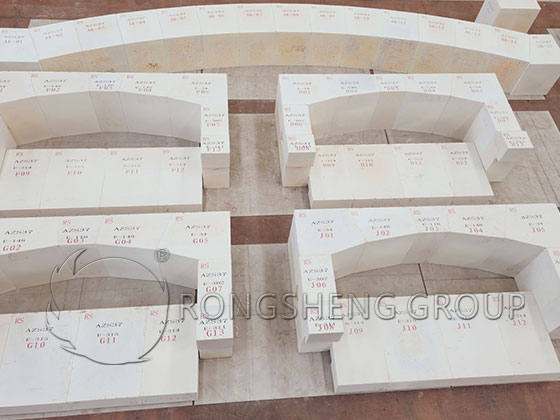
Fused Cast AZS 33#
Fused cast zirconia-corundum refractories (AZS) are refractory products made primarily from industrial alumina, zirconium sand, and desilicationized zirconium, with a small amount of Na₂O flux added in the form of sodium carbonate. They are melted in an electric arc furnace and then cast into shape. Typically, based on zirconium dioxide content, fused cast AZS refractories are classified into three grades: 33#, 36#, and 41# (AZS33#, AZS36#, AZS41#).
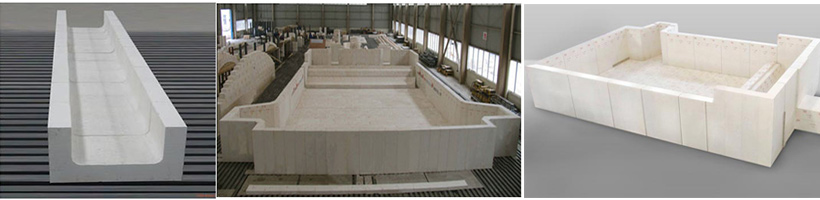
AZS33# is the most widely used and extensively used product in the fused cast AZS series. It is mainly suitable for the upper structure of the melting pool, the walls and bottom of the working pool, and the feed channel. AZS36#, in addition to having the same aluminum-zirconium eutectic as AZS33# fused zirconia-corundum bricks, also contains more chain-like zirconium oxide crystals and has a lower glass phase content, thus further enhancing its corrosion resistance. Therefore, it is suitable for areas with high glass melt flow rates or high temperatures, such as critical parts like the tank walls near hot spots in the melting pool. AZS41# contains more uniformly distributed zirconium oxide crystals, and among the AZS series products for fused casting, it has the best corrosion resistance. Therefore, it is selected for critical parts of glass furnaces, such as the corners of the feeding inlet, flow channels, furnace sills, and bubbling areas at the bottom of the pool, to ensure that the lifespan of these parts is balanced with that of other parts.
Fused Chromium Zirconium Corundum Bricks
Fused chromium zirconium corundum bricks are produced by introducing 10%–30% Cr2O3 into AZS-33 bricks using a shrinkage-free casting method. They are abbreviated as AZCS bricks. The surface and interior of the brick are dark green. The brick contains 4.5% shrinkage pores and has no interconnecting pores. The formation of an aluminum chromium spinel solid solution increases the viscosity of the glass phase, greatly improving its resistance to glass melt erosion. This resistance is 3.4 times that of fused AZS-33 bricks and 2.6 times that of fused AZS-41 bricks.
Features of Fused Zirconia-Corundum Bricks
Fused AZS refractories are indispensable furnace-building materials for glass melting furnaces, and their production technology and quality directly affect the quality of molten glass and the furnace life. AZS bricks, based on their zirconium oxide content, can be classified into three grades: 33#, 36#, and 41#. The main raw materials for fused zirconia-corundum bricks are industrial alumina (Al2O3 content > 98.5%), zircon sand (ZrO2 content > 65.6%), desilicationized zirconium (ZrO2 content > 85%), soda ash (Na2CO3 content not less than 99%), borax (B2O3 content not less than 37%), and rare earth oxides (Y2O3 content not less than 45%).
When industrial alumina and zircon sand are mixed in a 1:1 ratio, the resulting refractory material contains approximately 33% ZrO2, i.e., AZS33# brick. Another raw material for producing high-quality fused cast AZS bricks is desilicationized zirconium, so AZS36# and AZS41# bricks must use it, and AZS33% bricks also use desilicationized zirconium to improve performance. Industrial alumina is produced by chemically treating bauxite raw materials to remove oxides of silicon, iron, titanium, etc. It is a high-purity alumina raw material, with an Al2O3 content generally above 98%. Desilicationized zirconium is produced by smelting zircon concentrate in an electric arc furnace using carbon as a reducing agent.
Zircon, also called zirconite, contains 67.1% ZrO2 and 32.9% SiO2. Zircon has a melting point of 2550℃, does not shrink when heated to 1750℃, has a small coefficient of linear expansion, and is chemically inert, difficult to react with acids, does not react with some molten metals, and has strong resistance to glass melt erosion. Therefore, the characteristics of fused zirconium corundum bricks are as follows:
- (1) High temperature resistance.
- (2) High compressive strength.
- (3) Excellent thermal shock resistance.
- (4) High bulk density and good thermal conductivity.
- (5) Good wear resistance.
- (6) Good resistance to acid and alkali corrosion.
Applications of AZS Bricks
AZS bricks are mainly used in key parts of high-temperature industrial metallurgical furnaces, such as steel, metallurgy, electronics, petrochemicals, fertilizers, non-ferrous metals, and refractory materials, including glass furnaces, fiberglass furnaces, waste incinerators, and electric furnaces.