The firing temperature of mullite refractory bricks varies depending on the production process and raw materials. Here are some common variations:
- Sintered mullite refractory bricks are generally fired between 1500℃ and 1700℃. If the raw materials have high purity and fine particle size, or if sintering aids (such as TiO₂, Y₂O₃, etc.) are added, the firing temperature can be appropriately reduced to 1500℃-1600℃. For higher density and grain development, the temperature may need to be increased to 1650℃-1700℃.
- Electrominated mullite refractory bricks are fired at temperatures typically between 1700℃ and 1850℃ or even higher. This is to ensure sufficient mullite crystal development, resulting in better high-temperature performance and erosion resistance.
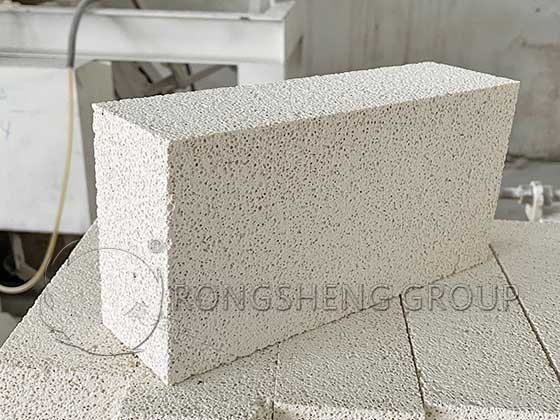
It should be noted that the specific firing temperature needs to be adjusted based on factors such as raw material ratios, brick thickness, and performance requirements. In actual production, the optimal temperature must be determined through experimentation.
Key Indicators of Mullite
What is Mullite? Mullite is a refractory material with 3Al₂O₃·2SiO₂ crystalline phase as its main component. Mullite is divided into two categories: natural mullite and synthetic mullite. Natural mullite is rare; it is generally synthesized artificially. The chemical composition of mullite is 71.8% Al₂O₃ and 28.2% SiO₂. Its mineral structure is orthorhombic, with crystals arranged in long columnar, acicular, or chain-like shapes. Acicular mullite interweaves to form a strong framework in finished products. Mullite is divided into three types: α-mullite, equivalent to pure 3Al₂O₃·2SiO₂, abbreviated as 3:2 type; β-mullite, with excess alumina in solid solution, resulting in a slightly expanded crystal lattice, abbreviated as 2:1 type; and γ-mullite, with small amounts of titanium oxide and ferric oxide in solid solution.
Mullite is chemically stable and insoluble in hydrofluoric acid. Its density is 3.03 g/cm³, Mohs hardness is 6-7, melting point is 1870℃, thermal conductivity (1000℃) is 13.8 W/(m·K), coefficient of linear expansion (20-1000℃) is 5.3 × 10⁻⁶/℃, and elastic modulus is 1.47 × 10¹º Pa. Due to its excellent high-temperature mechanical and thermal properties, synthetic mullite and its products exhibit advantages such as high density and purity, high high-temperature structural strength, low high-temperature creep rate, low thermal expansion coefficient, strong resistance to chemical corrosion, and thermal shock resistance. The key indicators for evaluating the quality of mullite are its phase composition and density.
As a high-temperature material, mullite possesses characteristics such as a high softening point under load, good creep and chemical corrosion resistance, a low coefficient of thermal expansion, and good thermal stability. Without added substances, mullite tends to form a glassy phase at grain boundaries, affecting the high-temperature performance of the material. When combined with corundum to form a corundum-mullite multiphase material, the formation of the glassy phase is reduced, significantly improving mechanical properties. Corundum-mullite multiphase materials combine the advantages of both single-phase materials, exhibiting excellent high-temperature strength, creep resistance, thermal shock resistance, and a high operating temperature (1650℃). They also possess good chemical stability and are unlikely to react with the substrate. They are particularly suitable for firing soft magnetic (ferrite) materials and electronic insulating ceramics.
Influence of Micropowders on the Properties of Corundum-Mullite Refractory Materials
Currently, corundum-mullite kiln furniture is commonly used in high-temperature pusher kilns. Compared with foreign products, domestic pusher bricks have a shorter lifespan and poorer stability, and their wear resistance and flexural strength are not ideal during application. They are prone to wear and breakage during use, especially in terms of thermal shock stability and creep resistance, which are the main reasons for poor pusher performance. Structure determines properties. Since corundum, mullite particles, and fine powders do not participate in the reaction during firing, the properties and structure of corundum-mullite materials are mainly determined by the content of silica micropowder and α-Al2O3 micropowder, as well as the firing temperature. Therefore, studying the influence of micropowders and firing temperature on the high-temperature properties of corundum-mullite materials is of practical significance.
(1) SiO2 micropowder, α-Al2O3 micropowder, and firing temperature all have a certain influence on structure and properties. α-Al2O3 micropowder has the greatest influence on high-temperature flexural strength. Next is SiO2 micropowder and firing temperature, with firing temperature having the greatest influence on thermal shock stability and creep resistance. Next were α-Al₂O₃ micropowder and silica micropowder. The optimal test conditions were: w(α-Al₂O₃ micropowder) = 11%, w(SiO₂ micropowder) = 3%, and a firing temperature of 1650℃. Under these conditions, the sample properties were: bulk density 2.96 g/cm³, porosity 18.5%, flexural strength loss percentage 30%, and creep percentage 0.99%.
(2) The α-Al₂O₃ micropowder, SiO₂ micropowder, and firing temperature have a significant impact on the bonding state between the particles and the matrix, as well as on the mullite, pores, and residual α-Al₂O₃ in the matrix. They also affect the coefficient of thermal expansion, elastic modulus, and thermal conductivity, ultimately affecting the thermal shock resistance of the material.
(3) The fracture of corundum mullite materials at room temperature is controlled by the crack propagation process, while at high temperatures it is controlled by the creep mechanism.